
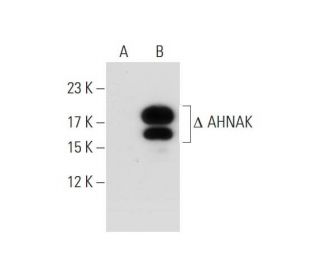


AHNAK Antibody (1G11): sc-134252
- AHNAK Antibody (1G11) is a mouse monoclonal IgG2a κ, cited in 2 publications, provided at 100 µg/ml
- raised against recombinant AHNAK protein of human origin
- recommended for detection of AHNAK of mouse, rat and human origin by WB, IP and ELISA
- At present, we have not yet completed the identification of the preferred secondary detection reagent(s) for AHNAK Antibody (1G11). This work is in progress.
QUICK LINKS
SEE ALSO...
AHNAK Antibody (1G11) is a mouse monoclonal IgG2a antibody that detects AHNAK in mouse, rat, and human samples through applications such as western blotting (WB), immunoprecipitation (IP), and enzyme-linked immunosorbent assay (ELISA). AHNAK, also known as neuroblast differentiation-associated protein AHNAK or desmoyokin, is a large protein consisting of 5,890 amino acids, encoded by the intronless AHNAK gene located on human chromosome 11q12. The protein features a complex structure with three main regions: a 251 amino acid N-terminus, a substantial central region of 4,390 amino acids characterized by multiple repeated units, and a 1,002 amino acid C-terminus. The central region is notable for its antiparallel beta-strands linked by loops, which may play a crucial role in its function. The C-terminal region contains several putative regulatory elements, including nuclear export localization signals, a leucine zipper, and potential phosphorylation sites for key kinases such as Akt1 and protein kinase C. These structural features suggest that AHNAK is a vital signaling molecule involved in various physiological processes, including neuronal cell differentiation and the modulation of cardiac L-type calcium channel function in response to beta-adrenergic stimulation. Anti-AHNAK antibody (1G11) serves as an essential tool for researchers studying AHNAK′s role in cellular signaling and differentiation.
Alexa Fluor® is a trademark of Molecular Probes Inc., OR., USA
LI-COR® and Odyssey® are registered trademarks of LI-COR Biosciences
AHNAK Antibody (1G11) References:
- Ahnak, a new player in beta-adrenergic regulation of the cardiac L-type Ca2+ channel. | Haase, H. 2007. Cardiovasc Res. 73: 19-25. PMID: 17045254
- AHNAK Loss in Mice Promotes Type II Pneumocyte Hyperplasia and Lung Tumor Development. | Park, JW., et al. 2018. Mol Cancer Res. 16: 1287-1298. PMID: 29724814
- Essential role of Ahnak in adipocyte differentiation leading to the transcriptional regulation of Bmpr1α expression. | Woo, JK., et al. 2018. Cell Death Dis. 9: 864. PMID: 30154465
- Ahnak scaffolds p11/Anxa2 complex and L-type voltage-gated calcium channel and modulates depressive behavior. | Jin, J., et al. 2020. Mol Psychiatry. 25: 1035-1049. PMID: 30760886
- AHNAK controls 53BP1-mediated p53 response by restraining 53BP1 oligomerization and phase separation. | Ghodke, I., et al. 2021. Mol Cell. 81: 2596-2610.e7. PMID: 33961796
- AHNAK suppresses ovarian cancer progression through the Wnt/β-catenin signaling pathway. | Cai, Y., et al. 2021. Aging (Albany NY). 13: 23579-23587. PMID: 34689136
- Ahnak depletion accelerates liver regeneration by modulating the TGF-β/Smad signaling pathway. | Yang, I., et al. 2022. BMB Rep. 55: 401-406. PMID: 35880432
- AHNAK Contributes to Hepatocellular Carcinoma Growth by Interacting with IGF-1R. | Li, K., et al. 2022. Molecules. 27: PMID: 36557813
- Ahnak is required to balance calcium ion homeostasis and smooth muscle development in the urinary system. | Lee, JM., et al. 2023. Cell Biosci. 13: 108. PMID: 37308968
- Silencing AHNAK promotes nasopharyngeal carcinoma progression by upregulating the ANXA2 protein. | Lu, X., et al. 2024. Cell Oncol (Dordr). 47: 833-850. PMID: 37962808
Ordering Information
| Product Name | Catalog # | UNIT | Price | Qty | FAVORITES | |
AHNAK Antibody (1G11) | sc-134252 | 100 µg/ml | $333.00 |