
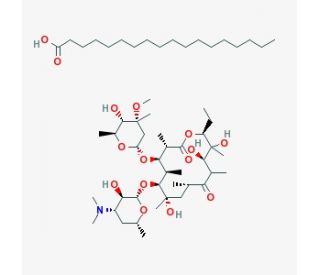

Erythromycin Stearate (CAS 643-22-1)
QUICK LINKS
Erythromycin Stearate, with the CAS number 643-22-1, is an esterified form of erythromycin, where the stearate (a long-chain fatty acid) improves the compound′s hydrophobicity and stability, making it suitable for various research applications that require controlled solubility characteristics. The primary action of erythromycin stearate at the molecular level involves binding to the 50S subunit of bacterial ribosomes, which inhibits protein synthesis by blocking the exit tunnel that growing peptide chains pass through. This action prevents the elongation of the protein, leading to an inhibition of bacterial growth. This specific mechanism is crucial in studying the translation process in prokaryotes and understanding how molecular structures within the ribosome facilitate or hinder the binding of molecules like erythromycin. In research, this compound is particularly useful in examining the effects of ribosomal inhibition on bacterial populations, exploring the dynamics of bacterial resistance, and studying the pharmacokinetics of erythromycin derivatives under various conditions. Furthermore, erythromycin stearate′s modified properties compared to its parent compound allow for detailed investigations into how alterations in molecular structure can influence the efficacy and behavior of a molecule within biological systems, providing insights into the design of more effective ribosome-targeting agents.
Erythromycin Stearate (CAS 643-22-1) References
- Erythromycin inhibits transcriptional activation of NF-kappaB, but not NFAT, through calcineurin-independent signaling in T cells. | Aoki, Y. and Kao, PN. 1999. Antimicrob Agents Chemother. 43: 2678-84. PMID: 10543746
- A comparative efficacy and safety study of clarithromycin, roxithromycin and erythromycin stearate in mild pneumonia. | Hatipoglu, ON. and Tasan, Y. 2000. Yonsei Med J. 41: 340-4. PMID: 10957888
- Erythromycin as a prokinetic agent: risk factors. | Berthet, S., et al. 2010. J Visc Surg. 147: e13-8. PMID: 20655290
- Enhanced interleukin production after long-term administration of erythromycin stearate. | Kita, E., et al. 1990. Pharmacology. 41: 177-83. PMID: 2080228
- Efficacy of erythromycin acistrate (2'-acetyl erythromycin stearate) and erythromycin stearate in experimental infections in mice. | Männistö, PT., et al. 1989. J Pharmacol Exp Ther. 250: 1028-33. PMID: 2778707
- A comparison of the various routes of administration of erythromycin in cattle. | Burrows, GE., et al. 1989. J Vet Pharmacol Ther. 12: 289-95. PMID: 2810478
- Effect of food on absorption of erythromycin. A study of two derivatives, the stearate and the base. | Malmborg, AS. 1979. J Antimicrob Chemother. 5: 591-9. PMID: 500517
- Inducible erythromycin resistance in bacteria. | Weisblum, B. 1984. Br Med Bull. 40: 47-53. PMID: 6442874
- Erythromycin-antacid interaction. | Arayne, MS. and Sultana, N. 1993. Pharmazie. 48: 599-602. PMID: 8415858
- Dental anxiety and the absorption of orally administered erythromycin stearate. | Coulter, WA., et al. 1995. Oral Surg Oral Med Oral Pathol Oral Radiol Endod. 80: 660-5. PMID: 8680971
Ordering Information
| Product Name | Catalog # | UNIT | Price | Qty | FAVORITES | |
Erythromycin Stearate, 10 g | sc-207634 | 10 g | $232.00 |