
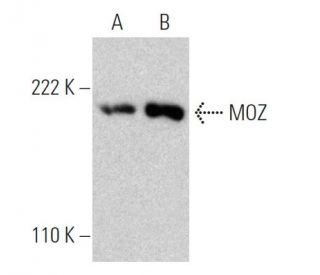


MOZ Antibody (4D8): sc-293283
- MOZ Antibody (4D8) is a mouse monoclonal IgG2b κ MOZ antibody provided at 100 µg/ml
- raised against a partial recombinant protein mapping within amino acids 81-179 of MOZ of human origin
- recommended for detection of MOZ of human origin by WB, IP, IF, IHC(P) and ELISA
- m-IgG2b BP-HRP is the preferred secondary detection reagent for MOZ Antibody (4D8) for WB and IHC(P) applications. This reagent is now offered in a bundle with MOZ Antibody (4D8) (see ordering information below).
QUICK LINKS
SEE ALSO...
MOZ Antibody (4D8) is a mouse monoclonal IgG2b kappa light chain antibody that detects MOZ protein of human origin by western blotting (WB), immunoprecipitation (IP), immunofluorescence (IF), immunohistochemistry with paraffin-embedded sections (IHCP), and enzyme-linked immunosorbent assay (ELISA). Anti-MOZ antibody (4D8) is available as the non-conjugated isotype antibody. MOZ protein, also known as monocytic leukemia zinc finger protein, plays a crucial role as a chromatin-associated histone acetyltransferase (HAT) essential for chromatin remodeling and transcription regulation. MOZ (4D8) monoclonal antibody facilitates the acetylation of histones, leading to a more open chromatin structure that allows transcription machinery to access DNA. MOZ protein has been implicated in acute myeloid leukemias due to involvement in variant translocations that result in the formation of MOZ fusion proteins, which can aberrantly enhance transcriptional activation through altered histone acetylation. MOZ (4D8) antibody interacts with other proteins such as MORF (MOZ-related factor) and Tip60, both sharing significant structural similarities and functional roles in transcriptional regulation. MORF possesses both HAT activity and transcriptional repression capabilities, while Tip60 is known for its role as a coactivator for various nuclear hormone receptors, further underscoring MOZ protein′s importance in cellular processes and potential implications in cancer biology.
Alexa Fluor® is a trademark of Molecular Probes Inc., OR., USA
LI-COR® and Odyssey® are registered trademarks of LI-COR Biosciences
MOZ Antibody (4D8) References:
- Tip60 is a nuclear hormone receptor coactivator. | Brady, ME., et al. 1999. J Biol Chem. 274: 17599-604. PMID: 10364196
- Identification of a human histone acetyltransferase related to monocytic leukemia zinc finger protein. | Champagne, N., et al. 1999. J Biol Chem. 274: 28528-36. PMID: 10497217
- Role of the MOZ/MLL-mediated transcriptional activation system for self-renewal in normal hematopoiesis and leukemogenesis. | Yokoyama, A. 2022. FEBS J. 289: 7987-8002. PMID: 34482632
- The role of MOZ/KAT6A in hematological malignancies and advances in MOZ/KAT6A inhibitors. | Su, J., et al. 2021. Pharmacol Res. 174: 105930. PMID: 34626770
- MOZ and Menin-MLL Complexes Are Complementary Regulators of Chromatin Association and Transcriptional Output in Gastrointestinal Stromal Tumor. | Hemming, ML., et al. 2022. Cancer Discov. 12: 1804-1823. PMID: 35499757
- MOZ is critical for the development of MOZ/MLL fusion-induced leukemia through regulation of Hoxa9/Meis1 expression. | Katsumoto, T., et al. 2022. Blood Adv. 6: 5527-5537. PMID: 35947126
- The translocation t(8;16)(p11;p13) of acute myeloid leukaemia fuses a putative acetyltransferase to the CREB-binding protein. | Borrow, J., et al. 1996. Nat Genet. 14: 33-41. PMID: 8782817
- mof, a putative acetyl transferase gene related to the Tip60 and MOZ human genes and to the SAS genes of yeast, is required for dosage compensation in Drosophila. | Hilfiker, A., et al. 1997. EMBO J. 16: 2054-60. PMID: 9155031
- Abnormalities of chromosome band 8p11 in leukemia: two clinical syndromes can be distinguished on the basis of MOZ involvement. | Aguiar, RC., et al. 1997. Blood. 90: 3130-5. PMID: 9376594
- Novel substrate specificity of the histone acetyltransferase activity of HIV-1-Tat interactive protein Tip60. | Yamamoto, T. and Horikoshi, M. 1997. J Biol Chem. 272: 30595-8. PMID: 9388189
- A novel fusion between MOZ and the nuclear receptor coactivator TIF2 in acute myeloid leukemia. | Carapeti, M., et al. 1998. Blood. 91: 3127-33. PMID: 9558366
- Roles of histone acetyltransferases and deacetylases in gene regulation. | Kuo, MH. and Allis, CD. 1998. Bioessays. 20: 615-26. PMID: 9780836
Ordering Information
| Product Name | Catalog # | UNIT | Price | Qty | FAVORITES | |
MOZ Antibody (4D8) | sc-293283 | 100 µg/ml | $316.00 | |||
MOZ Antibody (4D8): m-IgG2b BP-HRP Bundle | sc-548547 | 100 µg Ab; 10 µg BP | $354.00 |