
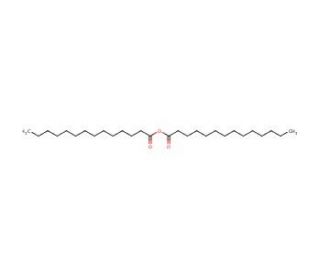

Myristic anhydride (CAS 626-29-9)
QUICK LINKS
Myristic anhydride, an organic compound derived from myristic acid, has been a subject of significant scientific research, particularly in the fields of organic synthesis, materials science, and surface modification. Its mechanism of action primarily revolves around its reactivity as an acylating agent, wherein the anhydride functional group readily reacts with nucleophiles such as alcohols and amines to form esters and amides, respectively. In research, myristic anhydride has been investigated for its role in the synthesis of specialty chemicals, pharmaceutical intermediates, and functionalized materials. Studies have explored its use as a key building block in organic transformations, including esterification, amidation, and ring-opening reactions, facilitating the preparation of diverse organic compounds with tailored properties. Furthermore, myristic anhydride has found applications in surface modification processes, where it serves as a reactive intermediate for grafting onto solid supports, nanoparticles, and polymers, imparting desirable functionalities such as hydrophobicity, biocompatibility, and chemical stability. Research efforts have focused on optimizing reaction conditions, exploring new synthetic routes, and elucidating reaction mechanisms to broaden the scope of its applications in various research fields. Overall, myristic anhydride presents a valuable tool in organic synthesis and materials science, offering opportunities for innovation and advancement in diverse scientific investigations.
Myristic anhydride (CAS 626-29-9) References
- Determination of incorporated amounts of poly(ethylene glycol)-derivatized lipids in liposomes for the physicochemical characterization of stealth liposomes. | Shimada, K., et al. 2000. Int J Pharm. 203: 255-63. PMID: 10967447
- FTIR-ATR spectroscopy for monitoring polyanhydride/anhydride-amine reactions. | Krishnan, M. and Flanagan, DR. 2000. J Control Release. 69: 273-81. PMID: 11064134
- A simplified assay for the enzyme responsible for the attachment of myristic acid to the N-terminal glycine residue of proteins, myristoyl-CoA: glycylpeptide N-myristoyltransferase. | McIlhinney, RA. and McGlone, K. 1989. Biochem J. 263: 387-91. PMID: 2597110
- Synthesis of saturated, unsaturated, spin-labeled, and fluorescent cholesteryl esters: Acylation of cholesterol using fatty acid anhydride and 4-pyrrolidinopyridine. | Patel, KM., et al. 1979. Lipids. 14: 816-8. PMID: 27520636
- Spatially resolved acyl transfer on surface by organo-catalytic scanning probe nanolithography (o-cSPL). | Botton, J., et al. 2018. Chem Sci. 9: 4280-4284. PMID: 29780559
- RESOLUTION OF A DISTRIBUTION OF DISTANCES BY FLUORESCENCE ENERGY TRANSFER AND FREQUENCY-DOMAIN FLUOROMETRY. | Lakowicz, JR., et al. 1987. Chem Phys Lett. 138: 587-593. PMID: 31839681
- A convenient synthesis of phosphatidylcholines: acylation of sn-glycero-3-phosphocholine with fatty acid anhydride and 4-pyrrolidinopyridine. | Patel, KM., et al. 1979. J Lipid Res. 20: 674-7. PMID: 490045
- Live and killed vaccines against toxoplasmosis in mice. | Waldeland, H. and Frenkel, JK. 1983. J Parasitol. 69: 60-5. PMID: 6827446
- Accumulation of N-acylethanolamine glycerophospholipids in infarcted myocardium. | Epps, DE., et al. 1980. Biochim Biophys Acta. 618: 420-30. PMID: 7397206
- Enhancement of rotavirus infectivity by saturated fatty acids. | Superti, F., et al. 1995. Comp Immunol Microbiol Infect Dis. 18: 129-35. PMID: 7621669
Ordering Information
| Product Name | Catalog # | UNIT | Price | Qty | FAVORITES | |
Myristic anhydride, 10 g | sc-211942 | 10 g | $119.00 |